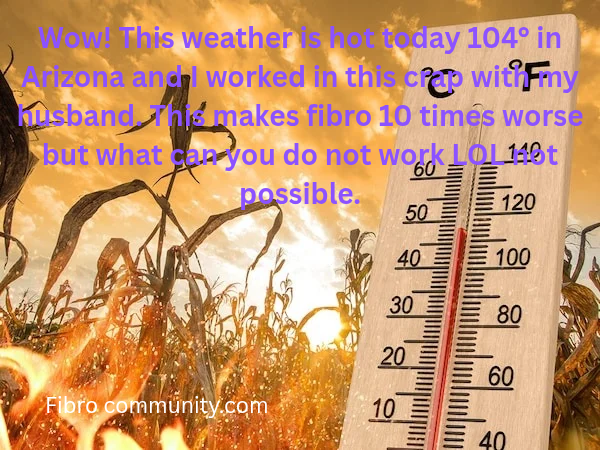
Wow! This weather is hot today 104° in Arizona and I worked in this crap with my husband. This makes fibro 10 times worse but what can you do not work LOL not possible.
- Upgrade Your Gear: Swap cotton for moisture-wicking, synthetic cooling fabrics [Summer SOS: heat intolerance].
- Targeted Cooling: Keep a few ice packs ready or use a hot water bottle filled with a 50/50 water and isopropyl alcohol mix to create a flexible, long-lasting ice pack [How do I cope with the drastic weather changes?]. [1]
- Nerve Relief: Apply menthol-based roll-ons to your neck and back; they work by tricking your brain into feeling cooler [How do I cope with the drastic weather changes?]. [1]
- Dietary Support: Snack on hydrating, refreshing foods like watermelon, cucumbers, and peaches [How do I cope with the drastic weather changes?].
As I scroll through all Fibromyalgia/ CFS groups on here and on Facebook, I see the same theme…
We have a heatwave in the UK ATM and majority of FM sufferers are going through more worse than normal pain cos of the heat is making the pain worse.
I’m the opposite though, Heat seems to ease the chronic pain and aches associated with Fibro.
However, a few months ago I remember it was quite chilly and my pain seemed to be A lot worse when it’s cold , kinda like Arthritis symptoms.
Anyone else has this blessing or being alright with warmer weather and horrific feeling in the cold weather?
The Link Between Fibromyalgia and Weather Changes
Research is slim, but many people with fibromyalgia have noticed a link
Many people with fibromyalgia say weather sensitivity is part of the condition. However, when you ask what kind of weather affects them most, the answers vary greatly.
If you talk to your healthcare provider about the impact of weather on how you feel, you could get any number of reactions—anything from, “I see that in a lot of my patients” to “That’s an old wives’ tale.” So do weather changes have a negative impact or not?
Weather & Fibromyalgia
A large internet survey involving nearly 2,600 people with fibromyalgia explored various factors affecting symptoms, although it wasn’t focused solely on weather. When asked about elements that seemed to worsen their symptoms, 80% of participants mentioned “weather changes.”1
Weather was the second most commonly reported trigger. The top five perceived triggers were:
Emotional distress: 83%
Weather changes: 80%
Sleeping problems: 79%
Strenuous activity: 70%
Mental stress: 68%
Of these, all except weather have been scientifically studied and identified as significant triggers.
What the Research Reveals
Research on the impact of weather on fibromyalgia symptoms is limited, but a few studies have been conducted.
A 2013 study published in Arthritis Care & Research involved 333 women with fibromyalgia. Participants documented their daily pain and fatigue, which were then compared to weather data.2
The study found a “significant but small” effect of weather changes on pain or fatigue in 10% of the 50 weather comparisons tried. Additionally, there were small inconsistencies in the reactions of different participants to weather changes.
The researchers concluded that the weather’s impact on fibromyalgia symptoms varies among individuals, stating:
“These findings do not rule out the possibility that weather-symptom relationships may exist for individual patients. Some patients may be more sensitive to weather or weather changes than other patients, and some patients may also be affected positively and other patients affected negatively by specific weather conditions.”
Interestingly, a 2017 review of Twitter data supported these findings, revealing regional differences in weather-related symptoms. This analysis showed no significant correlation between weather and symptoms in Colorado, Florida, Georgia, Minnesota, Ohio, and Texas. However, in California, humidity was a notable factor, while in New York, it was wind speed.3
For example, they say among the eight states with the most Twitter posts in the analysis, these six revealed no significant correlation between weather and symptoms:
- Colorado
- Florida
- Georgia
- Minnesota
- Ohio
- Texas